

Wirth's Law
Wirth's Law, formulated by computer scientist Niklaus Wirth in 1995, states plainly:
"Software is getting slower more rapidly than hardware becomes faster."
The basic idea is that software bloat, increasing abstraction layers, and feature creep cause programs to demand ever more resources, consistently outpacing the gains delivered by hardware improvements.
Much like the dynamic that unfolds under Parkinson's Law of Data, which states that "data expands to fill the space available for storage," software developers build products that inevitably push the performance limits of the latest hardware.
It's the inherent gap between concept-to-production timelines for software vs. hardware – the former measured in months, the latter in years – that propels Wirth's Law. Software continuously expands its resource demands to consume available compute capabilities.
Jevons Paradox
Jevons Paradox was formulated by English economist William Stanley Jevons in his 1865 work The Coal Question.¹ His observation was counterintuitive:
"When a resource becomes more efficiently used, total consumption of that resource tends to increase rather than decrease."
Jevons noticed that as steam engines became more fuel-efficient, England didn't use less coal. It in fact used dramatically more, because efficiency made coal-powered industry more economically attractive, spurring broader adoption and expansion.
The paradox works through a rebound effect:
Efficiency improves → the cost (in resources, money, or effort) to do something drops
Lower cost → the activity becomes more accessible and economically viable
Demand expands → more people do it, more often, at greater scale
Net consumption rises → the efficiency gains are more than offset by increased usage
Jevons Paradox challenges a deeply intuitive assumption — that doing things more efficiently is straightforwardly good for effective resource conservation. It suggests that efficiency and sufficiency are different things, and that without constraints on demand, efficiency improvements can paradoxically worsen the very problem they were meant to solve. In computing, this manifests as the eternal treadmill between hardware capability and software appetite — each feeding the other in an expanding cycle.
The AI Era Shift
Traditional software obeyed Wirth's Law somewhat passively. Bloat accumulated gradually — more abstraction layers, fatter frameworks, heavier UIs. The software drifted toward consuming available hardware.
AI is different. AI models don't drift toward consuming compute. They are architecturally designed to consume all available compute…and then the field immediately asks, "What happens if we give them more?".
The answer, empirically, has almost always been: they get better. This is the foundation of scaling laws — the empirical observation that model capability improves predictably with compute, data, and parameters.
This transforms the dynamic entirely.
Wirth's Law in AI: Not drift, but intent
In classical software, bloat was largely a side effect — laziness, abstraction overhead, feature creep. Engineers could have optimized; they chose not to because hardware would compensate.
In AI, the "bloat" is the point:
| Model | Year | Parameters |
|---|---|---|
| GPT-2 | 2019 | ~1.5 billion² |
| GPT-3 | 2020 | ~175 billion³ |
| GPT-4 | 2023 | ~1.8 trillion (mixture-of-experts)⁴ |
| Current frontier (GPT-5 family, Gemini 3, Claude, Grok 5) | 2025–2026 | 6–10 trillion (estimated)⁵ |
One important nuance has emerged since the dense-model era: mixture-of-experts is now the default frontier architecture, decoupling total parameters from per-token compute. DeepSeek-V3, for example, holds 671 billion parameters but activates only ~37 billion per token.⁶
But this doesn't weaken the Wirth dynamic; it relocates it. Compute freed by sparsity is reinvested in longer training runs, more post-training, and a new axis entirely: test-time reasoning, where models burn orders of magnitude more compute per query to "think" before answering. When pre-training gains slowed around 2024–2025, the field didn't shrink its compute appetite — it found new dimensions to scale.
Each generation is still conceived to require hardware that doesn't yet exist at design time. Wirth's Law here isn't a critique of inefficiency — it's a deliberate engineering strategy.
Jevons Paradox in AI: Efficiency as accelerant
Each time AI compute becomes more efficient, the field does not consolidate gains. It immediately reinvests them into scale.
Algorithmic improvements
Should reduce compute for a given capability → instead fund larger training runs chasing the next threshold.
Hardware improvements (H100 → Blackwell → Rubin)
Should make existing workloads cheaper → instead make unthinkable scales tractable.
NVIDIA's GB200 racks cut cost-per-token by roughly an order of magnitude — and demand outstripped supply anyway.
Inference optimization (quantization, distillation, sparse attention)
Should reduce serving costs → instead, cheaper tokens enabled the reasoning and agentic era, where one task consumes thousands of times the tokens of a chat reply.
Inference, once an afterthought, is projected to account for the majority of all AI compute by 2030.
Cheap, capable small models
Should reduce datacenter load → instead enable on-device inference across billions of devices and AI embedded in every product surface, creating net-new demand that didn't exist before.
The cleanest natural experiment came in January 2025, the "DeepSeek moment." When DeepSeek published a frontier-class model reportedly trained for under $6 million,⁷ markets briefly concluded that efficiency meant less demand: NVIDIA lost ~17% of its value in a day.⁸
Microsoft's CEO publicly invoked Jevons Paradox in response⁹ and was vindicated within months as cheap frontier capability sent total compute demand up. Every efficiency gain became a demand unlock, not a demand reducer. Jevons unfolding in plain sight, in real time.
The Mutual Feedback Loop
The interaction of Wirth's Law and Jevons Paradox as impelling forces of modern AI compute is best visualized as a mutual feedback loop:
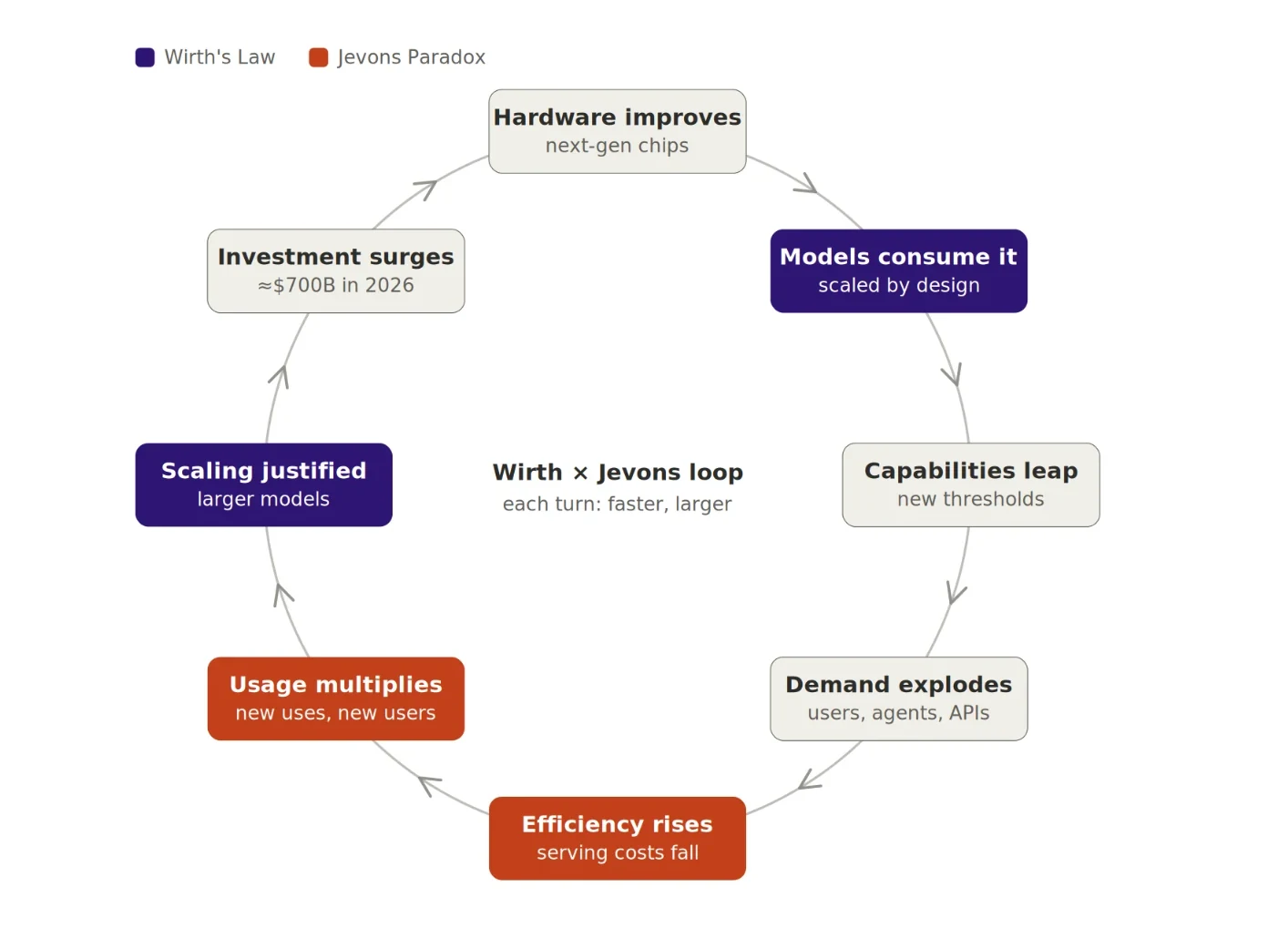
Figure 1. The Wirth × Jevons mutual feedback loop in AI compute.
This loop is conspicuously visible in capital flows: combined hyperscaler CapEx went from roughly $200 billion in 2024 to ~$700 billion committed for 2026, increasingly funded by debt.¹⁰ This is an accelerating flywheel – each revolution of the loop operates faster and at greater scale than the last.
The Energy Consequence
This is where the intersection becomes a civilizational-scale concern:
- A single frontier training run consumes tens of gigawatt-hours; inference at scale adds a far larger ongoing load.
- The IEA projects data center electricity consumption to roughly double from ~485 TWh in 2025 to ~950 TWh by 2030, with AI's share tripling — despite anticipated efficiency gains.¹¹
- No hyperscaler has formally abandoned net-zero energy goals, but the trajectory tells the story: Google's emissions are up ~50% since 2019 and its 2030 goal is now an "ambition."¹² Microsoft's footprint is up over 23% since its carbon-negative pledge.¹³ Intensity per unit of compute falls; absolute emissions rise.
- Power, not chips, is now the binding constraint driving gas turbine backlogs, nuclear restarts (Three Mile Island, under a 20-year Microsoft contract), and SMR contracts.
The Deeper Philosophical Tension
There is a profound irony in all of this. AI is increasingly proposed as a tool to solve resource & energy challenges – optimizing grids, accelerating materials discovery, designing more efficient industrial processes. It may well do those things. But in doing so, it will demonstrate capabilities that justify more AI investment, lower the cost of deployment, and expand total compute demand further.
The very tool proposed to escape the paradox may be the most powerful engine of the paradox ever constructed.
Whether AI's efficiency gains across the broader economy outpace its own resource consumption remains one of the genuinely open questions of the decade.
(Not so) Hot take: It ain't looking so good thus far.
Pressure-testing the Escape Valves
The classic candidate for breaking the loop was a scaling-law plateau: if more compute stops producing capability gains, the incentive to scale collapses.
That thesis has now been partially tested…and it failed instructively.
Pre-training scaling did hit diminishing returns around 2024–2025. Yet the loop didn't break; it rerouted. Post-training and test-time compute opened new scaling axes, and demand shifted toward inference (much as the end of CPU clock-speed scaling slowed nothing once the industry pivoted to multicore).
Betting on a plateau now means betting that every axis — pre-training, post-training, inference-time, and ones not yet invented — saturates at once. Possible, but no longer the most plausible brake.
Two other escape valves deserve more weight:
Economic Discipline
A Jevons backfire requires demand that stays elastic. The loop currently runs ahead of revenue: hundreds of billions in annual CapEx against AI revenues that remain a fraction of the buildout. If demand saturates before the investment is recouped, capital markets – not physics – halt the cycle, with echoes of the dot-com fiber overbuild.
Physical Friction
Power generation, grid interconnection, transformers, and memory supply all move on multi-year timescales no amount of capital can compress. These don't break the loop, but they act as governors on its speed…and they are already biting.
"Jane, get me off this crazy thing!"
The realistic question is not whether the loop has a natural equilibrium; within current paradigms, it doesn't. The pivotal question is which brake engages first: capital discipline, physical limits, or genuine saturation across every scaling axis?
Or perhaps there's another factor hiding quietly within the loop itself – a form of untapped potential not yet unleashed…or a short already in the wiring.
Fuel or firebreak, a force strong enough to alter the loop's seemingly unstoppable momentum is worthy of its own exploration…
References
- William Stanley Jevons, The Coal Question, 1865.
- Radford et al., "Language Models are Unsupervised Multitask Learners," OpenAI, 2019. OpenAI
- Brown et al., "Language Models are Few-Shot Learners," NeurIPS 2020. arXiv
- GPT-4 mixture-of-experts architecture and parameter estimate (~1.8 trillion). Not officially confirmed by OpenAI; widely reported. SemiAnalysis
- Frontier model parameter estimates (6–10 trillion range) for current-generation sparse architectures. Based on analyst reporting; labeled as estimates.
- DeepSeek-AI, "DeepSeek-V3 Technical Report," December 2024. arXiv
- DeepSeek-V3 training cost reported at under $6 million. From the DeepSeek technical report and subsequent press coverage.
- NVIDIA stock declined roughly 17% on January 27, 2025, following the DeepSeek-V3 release. Multiple financial news sources.
- Satya Nadella, CEO of Microsoft, publicly invoked Jevons Paradox in response to the DeepSeek moment, January–February 2025.
- Hyperscaler CapEx from roughly $200 billion (2024) to roughly $700 billion (2026 commitments). Goldman Sachs Global Institute, May 2026. Goldman Sachs
- IEA, "Electricity 2025," January 2025. IEA
- Google Environmental Report 2024. Google
- Microsoft Environmental Sustainability Report 2024. Microsoft